
AI Operations Enhancing Incident Management with AI
December 2025
Straight To The Point
Financial institutions face mounting pressure to ensure resilience, transparency, and reliability in their operations. This paper argues that integrating AI into incident management transforms operations from reactive firefighting into proactive resilience. By combining predictive analytics, intelligent automation, and structured governance, AI enables faster detection, smarter decision-making, and auditable recovery. The result is not just improved operational efficiency, but a redefinition of resilience as a competitive differentiator in a high-stakes regulatory and customer environment.
Incident Practices are Changing
Financial services organizations are operating in an environment of constant change, where speed and reliability determine market advantage. As systems grow in complexity, the likelihood of disruption increases. Traditional incident response methods, built for linear and predictable environments, are no longer sufficient. AI offers the means to evolve incident operations from reactive management to proactive resilience.
External Drivers:
- Regulatory Pressure –Regulators are elevating operational resilience from guidance to enforceable obligation. DORA in the EU, the UK’s Operational Resilience Policy, and the U.S. SEC’s four-day incident disclosure rule each demand measurable readiness, transparent reporting, and documented recovery capabilities. These frameworks are now shaping how CIOs and CTOs demonstrate control to boards, auditors, and regulators.
- Customer and Market Expectations– Modern customers expect continuous digital availability. Even short outages cause reputational damage, operational disruption, and customer attrition. In highly digital sectors such as banking, healthcare, and retail, downtime is not viewed as a technical issue but as a trust issue.
- Technology and Ecosystem Complexity –Enterprise technology stacks are increasingly distributed and interdependent. Multi-cloud architectures, API-based ecosystems, and third-party SaaS integrations expand the surface area for incidents. When a failure occurs, it often propagates across layers and partners before detection. For incident operations, this requires smarter orchestration across detection, escalation, and recovery to restore service and mitigate risk.
AI Maturity and Opportunity
Advances in predictive analytics, natural language processing, and AIOps create new opportunities to detect anomalies earlier and support faster, evidence-based decisions. Yet many organizations fail to realize this potential because their data is fragmented, ungoverned, and inaccessible to AI systems. The future advantage will belong to those who integrate AI into structured governance and operational workflows.
Organizations that integrate AI into incident operations can redefine resilience as a strategic differentiator. By aligning governance, practitioner productivity, and automation, they can reduce downtime, improve transparency, optimize workforce, and meet regulatory expectations. The result is a capability that anticipates failure, accelerates recovery, and strengthens customer and regulator confidence.
AI-enabled incident operations are not about replacing human judgment but about amplifying it. The organizations that succeed will treat AI as a disciplined partner in decision-making, not as a disconnected tool. Predictive, auditable, and data-driven operations will define the next era of operational excellence.
AI Imperatives
AI is redefining how enterprises manage disruption. Traditional incident operations depend on human judgment after failure occurs. This reactive model cannot keep pace with today’s scale and interconnected systems. AI enables prediction, precision, and speed, allowing organizations to move from response to prevention. For CIOs and CTOs, the challenge is implementing AI that strengthens control, transparency, and reliability.
Automation handles routine actions. Intelligence interprets context and improves outcomes. AI can synthesize signals across monitoring, infrastructure, and business systems to find what truly matters. It helps leaders detect risk early, guide response decisions, and continuously learn from every event. The result is faster recovery, consistent reporting, and sustained operational trust.
Strategic Imperatives for AI in Operations
- Predict Early: Use AI to identify weak signals and prevent outages before they affect customers.
- Decide Efficiently: Empower teams with AI insights that guide triage and restoration in real time.
- Communicate Clearly: Generate accurate summaries and stakeholder updates that maintain confidence during disruption.
- Learn Continuously: Capture lessons from every incident and apply them to strengthen future resilience.
- Govern Effectively: Maintain visibility and auditability over how AI systems operate and make recommendations.
Key Strategic Outcomes
- Faster mean time to detection (MTTD) and mean time to resolve (MTTR)
- Reduced manual effort and responder toil
- Improved accuracy in incident categorization and classification
- Consistent and accurate communications and reporting
- Greater visibility into operational health and risk posture
- Higher customer satisfaction and reduced service disruption
Adopting AI in incident operations requires disciplined leadership. Technology executives must define oversight boundaries, set performance expectations, and ensure transparency in AI behavior. Success depends on responsible design, quality data, and measurable impact.
AI enhances the partnership between people and systems. When governed and applied with purpose, it transforms incident operations into a proactive, intelligence-driven capability that protects both service reliability and customer trust.
Operational Priorities for AI
Three essential priorities guide the responsible and effective use of AI in incident operations. Each represents a strategic pillar that enables CIOs and CTOs to align investment, talent, and technology toward measurable outcomes. When applied together, they create a balanced model of control, efficiency, and resilience.
1. Governance
Establish AI-driven governance to enforce consistent standards for how incidents are detected, escalated, and resolved.
Leveraging AI for process governance enhances alignment to standards and procedures, resulting in better data quality. With more accessible and accurate reporting that provides real-time visibility and maps incidents to risks, AI strengthens oversight and enables more informed post-incident analysis.
Key Use Cases
- NLP dashboards
- Regulatory reporting
- Risk Mapping
- Policy Control
- Data Enrichment
- Quality and hygiene
Benefits
- Improved transparency and oversight
- Stronger regulatory alignment
- Standardized incident handling
- Clear accountability
2. Practitioner Productivity
Empower responders with intelligent tools that simplify data gathering, reduce manual effort, and accelerate recovery.
Responders are overloaded by alerts, fragmented data, and repetitive updates. AI improves their productivity by summarizing complex information, identifying next actions, and automating communication so teams can focus on restoration rather than coordination.
Key Use Cases
- Situation reporting
- Virtual assistant
- Incident routing
- Communications
- Record relation
- Telemetry querying
Benefits
- Reduced manual workload and toil
- Accelerated decision making
- Increased responder focus on resolution
- Faster mean time to detection (MTTD)
3. Intelligent Automation
Integrate automation that orchestrates incident response using AI and runbooks to speed decisions and improve accuracy.
Intelligent automation determines when to act, what to execute, and when to involve humans. It removes manual toil, applies actions consistently, and accelerates containment and recovery while reducing overhead. Combining human judgment with machine precision delivers faster, more reliable outcomes at scale.
Key Use Cases
- Alert correlation
- Triage initiation
- Impact assessment
- Impact forecasting
- Autonomous coordination
- On-call orchestration
Benefits
- Accelerated response timelines (MTTR)
- Fewer recurring incidents
- Lower operational cost and risks
- Optimized staffing requirements (e.g., eyes on glass)
The Bottom Line
Governance ensures control, productivity delivers speed, and automation enables scale. When combined, these pillars transform incident management from reactive recovery into proactive resilience that builds trust with customers, regulators, and leadership.
AI Capability Maturation
A Crawl, Walk, Run approach gives large enterprises a structured path to adopt AI safely and effectively across incident operations. It allows leaders to demonstrate value early, build confidence, and scale capabilities without disrupting existing governance or risk frameworks. Starting small with high‑impact pilots creates measurable wins that justify broader integration. The approach ensures each stage strengthens data quality, control, and accountability before automation is expanded. For CIOs and CTOs, this phased progression turns AI from an experiment into an enterprise‑ready capability that improves resilience and operational trust.
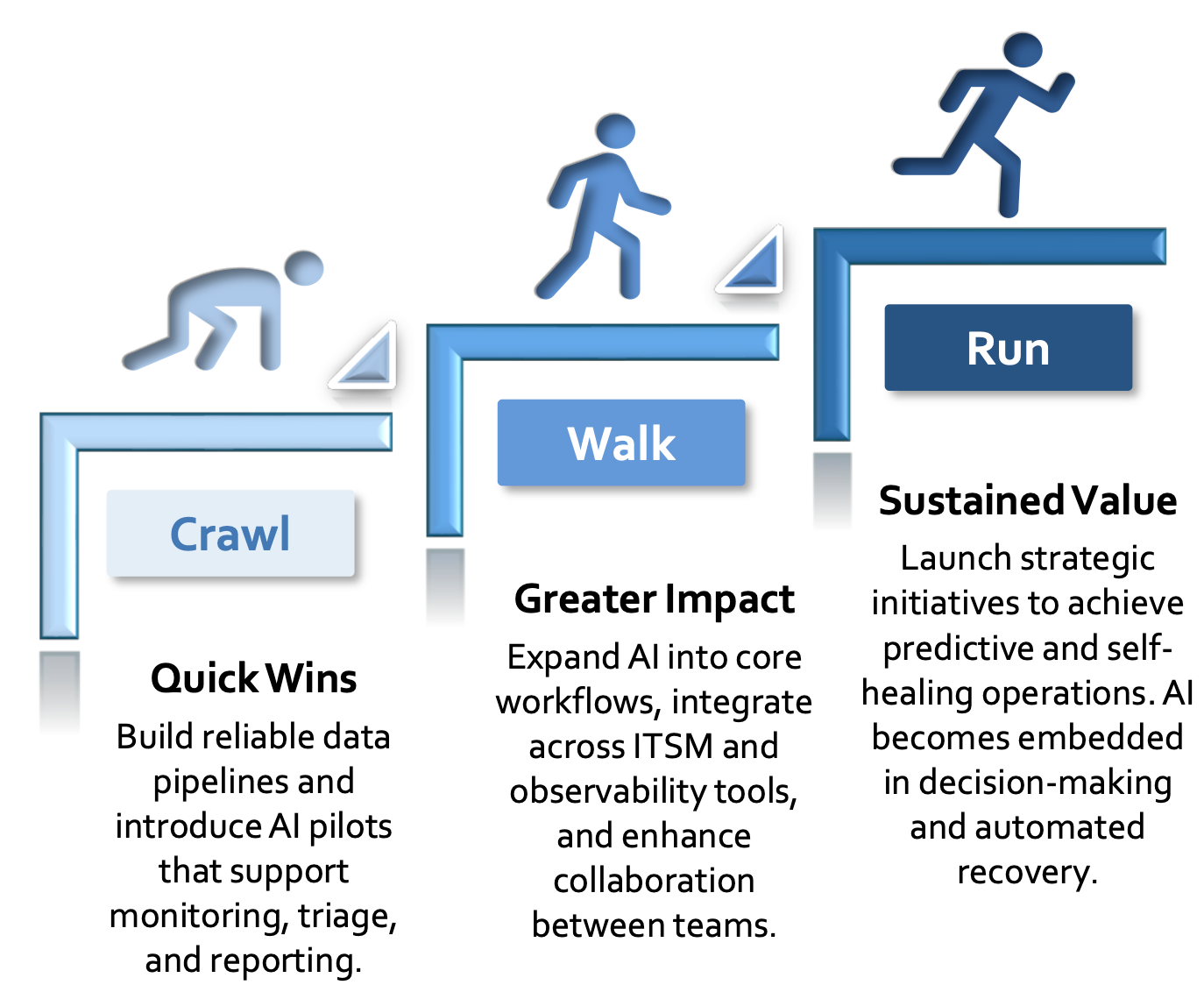
Enterprises that succeed with AI in incident operations understand that maturity is not only technical but cultural. Each stage of progress builds confidence, skill, and institutional trust in data-driven decision-making. The journey ensures that teams learn to rely on AI as a disciplined partner rather than a separate system.
By moving through Crawl, Walk, and Run tactically and strategically, organizations create lasting value. They balance speed with control, visibility with automation, and innovation with accountability, turning operational resilience into a measurable competitive advantage.
Crawl, Walk, Run
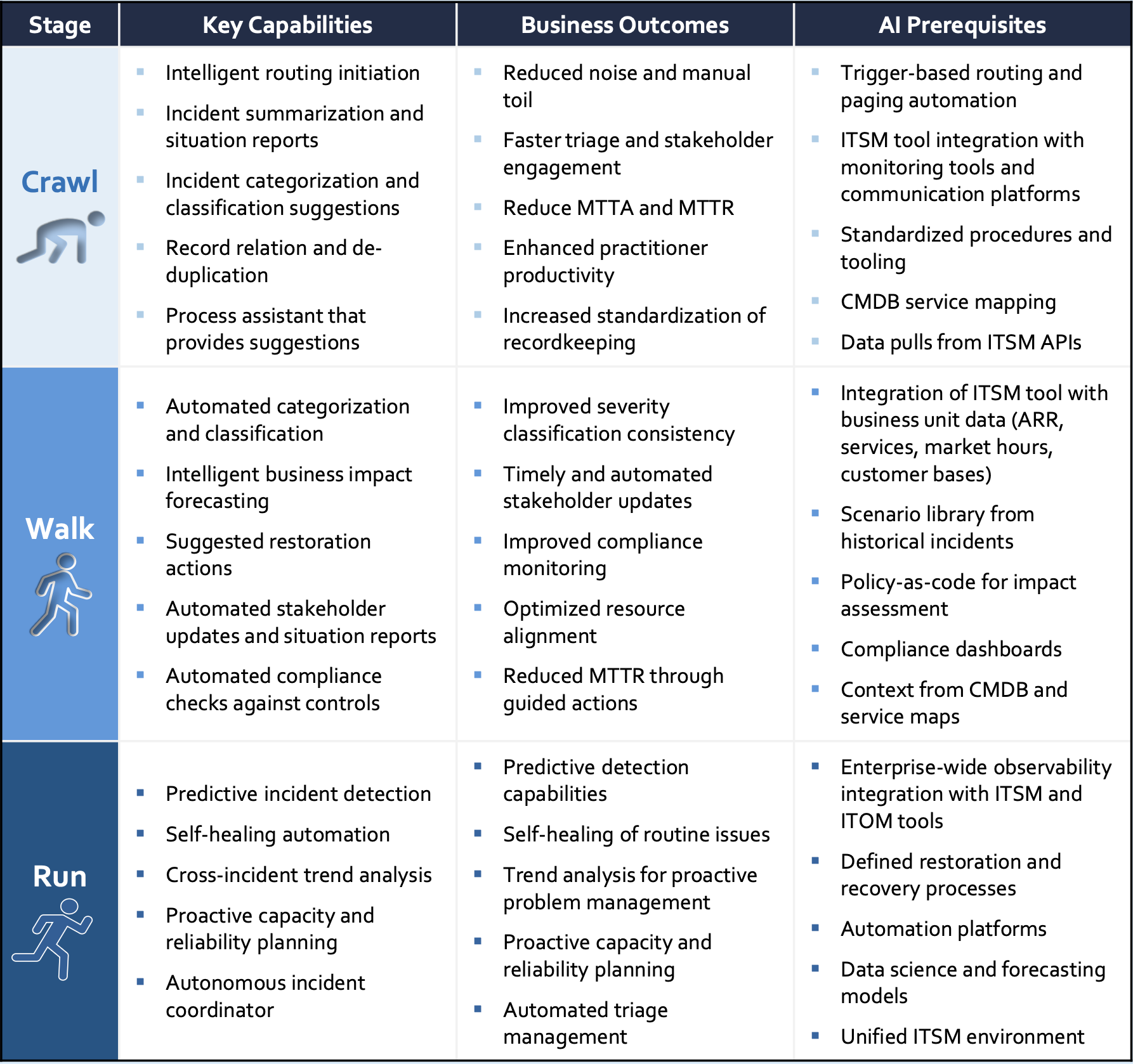
Building AI capabilities in incident management requires a structured, phased approach aligned to each organization’s current maturity and system readiness. The Crawl, Walk, Run approach exemplifies how enterprises can evolve from foundational efficiency gains to advanced, self-healing operations. AI adoption begins with improving speed and efficiency in triage and response, supported by the right data, tools, and governance. As maturity grows, AI becomes predictive and autonomous, helping teams prevent incidents before they occur and driving greater resilience, consistency, and operational trust across the enterprise.
The Intelligent Ecosystem
Enterprises already have a wide range of monitoring, workflow, and collaboration tools, but these systems often operate in isolation. The real opportunity lies in connecting them through AI-driven integration. By aligning observability, automation, and communication platforms under a single governance framework, organizations can create an intelligent ecosystem that anticipates issues and accelerates resolution.
Modern incident operations require seamless data flow between monitoring systems, AIOps platforms, and ITSM tools. AI strengthens these integrations by interpreting telemetry, surfacing insights, and enabling automation without compromising control. This connected platform transforms fragmented workflows into an adaptive environment that reacts faster, learns continuously, and reports with accuracy.

Conclusion
The evolution of incident operations in financial services reflects a deliberate shift from reactive response to proactive resilience. As systems grow in complexity and regulatory expectations increase, AI provides the structure to improve reliability, transparency, and speed without compromising control. When integrated responsibly, AI strengthens the foundation of operational resilience by improving efficiency, consistency, and foresight across every stage of incident operations.
Key Takeaways
- AI as a Strategic Differentiator – AI is no longer an experimental technology but a core enabler of operational excellence. When embedded in governance and control frameworks, it enhances transparency, accountability, and speed across the incident lifecycle.
- From Response to Resilience – AI transforms incident management from reactive recovery to predictive prevention. By learning from data across monitoring, infrastructure, and service systems, institutions can anticipate disruptions earlier and accelerate restoration when they occur.
- Human Expertise Amplified by Automation – AI enhances rather than replaces human decision-making. By automating repetitive processes and surfacing insights, it allows practitioners to focus on judgment, communication, and restoration.
- AI as the Unifying Bridge – AI connects previously siloed monitoring, workflow, and communication systems into a cohesive ecosystem. By interpreting data across platforms and enabling intelligent automation, it transforms fragmented operations into an adaptive, transparent, and collaborative environment.
- The Future is Predictive and Self-Healing – With maturity, AI-driven systems will evolve from automation to autonomy, capable of identifying issues, orchestrating responses, and validating recovery outcomes without human intervention. This evolution strengthens both resilience and control across critical operations.
As organizations mature, the focus will shift to deeper integration, greater automation, predictive intelligence, and self-healing capabilities. Incident operations will become faster, safer, and continuously learning, enabling financial services organizations to sustain resilience and trust in an increasingly complex environment.


About Reference Point
Reference Point is a strategy, management, and technology consulting firm focused on delivering impactful solutions for the financial services industry. We combine proven experience and practical experience in a unique consulting model to give clients superior quality and superior value. Our engagements are led by former industry executives, supported by top-tier consultants. We partner with our clients to assess challenges and opportunities, create practical strategies, and implement new solutions to drive measurable value for them and their organizations.